
In an urban farm, containers are not accessories. They are the garden!
Once you know what to grow, the next question is where those plants will live — because in container gardening, the container is the garden.
Containers are the “soil” of the urban farm. They are the foundation. If you pick the right container, everything else becomes easier. If you pick the wrong one, you’ll spend the season chasing problems.
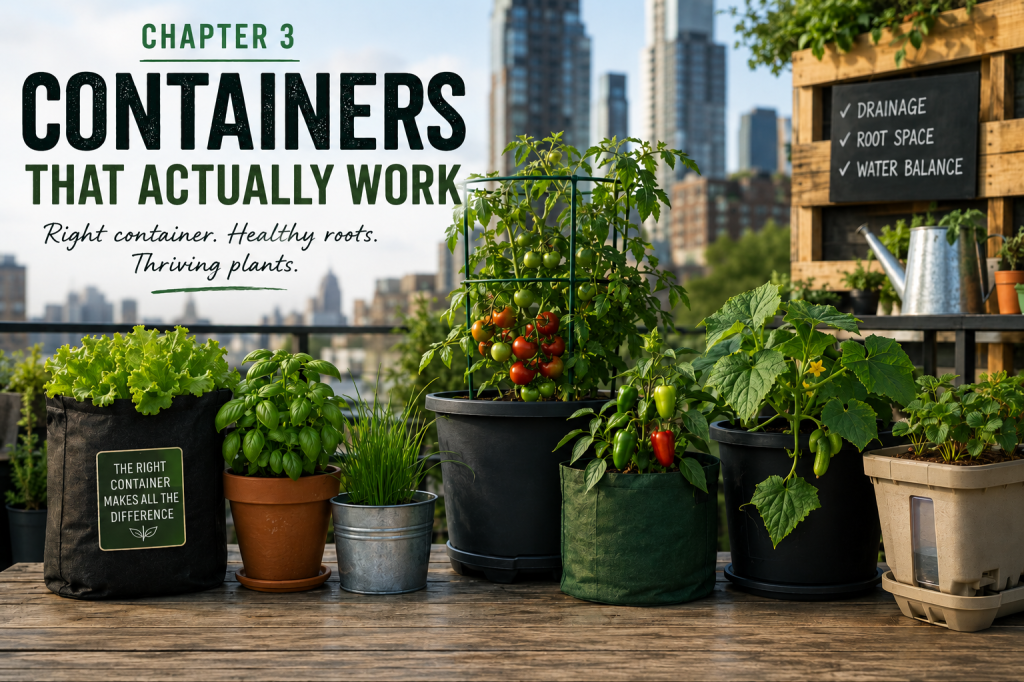
A container garden can be simple—just a few pots and good sunlight. But the container choice still matters, because it controls three big things:
- Root space
- Drainage and oxygen
- Water consistency
This chapter will help you choose containers that support healthy plants instead of fighting them.
Gary’s Garden Note
Most container “failures” aren’t about gardening skills. They’re about containers that don’t match the plant.
Everything that happens above the soil line—growth, flowering, fruiting, harvest—depends on what happens below it. When containers work, plants thrive. When they don’t, even experienced gardeners struggle to compensate.
Most container gardening problems aren’t caused by poor weather, bad luck, or even plant choice. They’re caused by containers that don’t support healthy roots.
This chapter is about choosing containers that actually work—not because they’re trendy or decorative, but because they meet the biological needs of plants.
Gary’s Garden Note
In container gardening, success starts at the root zone.
Why Containers Matter More Than Most Gardeners Realize
In the ground, soil acts as a safety net.
It holds moisture, stores nutrients, moderates temperature, and gives roots room to explore. Containers remove that buffer. In exchange, they offer control—but only if they’re chosen wisely.
In containers:
- Roots are confined to a fixed volume
- Water enters and exits quickly
- Nutrients must be replaced regularly
- Temperature fluctuates more dramatically
Because of these factors, the container itself becomes part of the growing system. It determines how much water is available, how evenly moisture is distributed, how stable temperatures remain, and how well roots can function.
Gary’s Garden Note
A good container makes gardening easier. A bad one makes everything harder.
Drainage Is Non-Negotiable
If there is one rule that cannot be bent in container gardening, it is this:
Water must be able to leave the container.
Roots need oxygen as much as they need moisture. When containers hold water at the bottom, roots suffocate. Growth slows. Disease pressure increases. Plants decline.
Effective containers:
- Have drainage holes or overflow ports
- Allow water to move through the entire soil profile
- Never trap stagnant water in the root zone
Decorative pots without drainage are best used as outer shells, with a functional container placed inside.
Gary’s Garden Note
If water can’t get out, roots can’t breathe.
Why Garden Soil Doesn’t Belong in Containers
Garden soil feels familiar, but it’s one of the worst choices for containers.
Native soil is heavy, dense, and prone to compaction. In containers, it drains poorly, restricts airflow, and quickly becomes anaerobic.
Soilless potting mixes are designed specifically for containers. They are lighter, more porous, and engineered to balance drainage with moisture retention.
A quality potting mix:
- Drains freely
- Holds moisture evenly
- Resists compaction
- Supports healthy root growth
Using the right mix is one of the fastest ways to improve container garden performance.
Gary’s Garden Note
Potting mix isn’t fancy soil — it’s engineered for containers.
Container Size: Bigger Is Usually Better
One of the most common mistakes gardeners make is choosing containers that are too small.
Small containers:
- Dry out quickly
- Heat up rapidly
- Run out of nutrients faster
- Restrict root growth
Larger containers buffer all of these stresses. They hold more water, maintain more stable temperatures, and provide room for roots to develop fully.
That doesn’t mean every container needs to be enormous. It means container size should match plant size.
Gary’s Garden Note
A cramped root system never reaches its potential.
Sidebar: Minimum Container Size Guidelines
General Rule:
The more above-ground growth a plant produces, the more below-ground space it needs.
| Plant Type | Minimum Container Size |
| Herbs (basil, parsley) | 1–3 gallons |
| 3 | 2–5 gallons |
| Peppers | 5–7 gallons |
| Bush tomatoes | 7–10 gallons |
| Indeterminate tomatoes | 7–10 gallons |
| Cucumbers | 5–10 gallons |
| Dwarf squash | 7–10 gallons |
Container Depth Matters as Much as Width
Roots don’t just grow outward—they grow downward.
Shallow containers restrict root development, even if the container is wide. Many fruiting crops require depth to support anchoring roots and moisture reserves.
As a general guideline:
- Shallow containers suit greens and herbs
- Medium-depth containers suit peppers and compact vegetables
- Deep containers suit tomatoes, squash, and long-season crops
Matching depth to crop prevents stress and improves productivity.
Traditional Pots, Fabric Bags, and Sub-Irrigated Containers
There is no single “best” container system.
Each type has strengths and limitations.
Traditional Pots
- Widely available
- Durable
- Easy to move
They require careful watering and good drainage but work well for many crops.
Fabric Grow Bags
- Excellent drainage and aeration
- Encourage fibrous root systems
- Lightweight and affordable
They dry out faster but perform well with consistent watering.
Sub-Irrigated Containers
- Store water in a lower reservoir
- Reduce watering frequency
- Improve moisture consistency
They’re especially useful for gardeners managing many containers or dealing with hot weather.
Gary’s Garden Note
The best container is the one that matches your habits.
Stability Matters More Than Appearance
A productive container garden must be stable.
Tall plants become top-heavy quickly, especially when loaded with fruit. Lightweight containers can tip over during storms or when plants mature.
Stability considerations include:
- Wide bases
- Adequate weight
- Secure placement
- Anchoring tall containers
A container that tips over mid-season often breaks plants beyond recovery.
Gary’s Garden Note
A container that stays upright protects months of work.
Table: Best Crops by Container Size
1–3 Gallon Containers
Best for short-season, shallow-rooted crops.
- Basil
- Parsley
- Cilantro
- Lettuce
- Spinach
- Green onions
5–7 Gallon Containers
Ideal for compact fruiting crops.
- Peppers
- Bush cucumbers
- Compact eggplant
- Dwarf tomatoes
7-10 Gallon Containers
Support larger, longer-season plants.
- Indeterminate tomatoes
- Squash (compact varieties)
- Large peppers
- Pole beans (with support)
7-10 Gallon Containers
Best for maximum production and reduced stress.
- Large tomato varieties
- Mixed plantings
- Long-season crops
Containers as a Design Strategy
Containers are not just planting vessels — they’re design tools.
They allow gardeners to:
- Move plants to better light
- Adjust spacing mid-season
- Replace underperforming crops easily
- Rotate crops between seasons
This flexibility is one of the greatest advantages of urban farming.
Gary’s Garden Note
Containers let the garden adapt as the season changes.
Reuse, Refresh, Repeat
Containers don’t have to be replaced each season.
At the end of a crop cycle:
- Remove spent plants
- Refresh potting mix
- Replenish nutrients
- Replant
This turnover keeps containers productive year-round and reduces waste.
Containers as the Foundation of the System
When containers are chosen intentionally, everything else becomes easier.
Watering is more predictable. Feeding is more efficient. Plants grow stronger. Problems are easier to manage.
Containers don’t limit urban farms — they enable them.
Quick Takeaways
- Containers are the foundation of the urban farm.
- Drainage is essential for healthy roots.
- Garden soil does not belong in containers.
- Larger containers buffer heat, moisture, and nutrients better.
- Fabric bags and sub-irrigated planters both have advantages.
- Consistent moisture solves many container problems.
- Simple setups often work best.
Gary’s Garden Note
A good container doesn’t make gardening flashy—it makes it easier.
Urban Farm Checklist: Containers
☐ Choose containers with drainage holes or overflow systems
☐ Match container size to the mature size of the plant
☐ Use high-quality soilless potting mix
☐ Avoid shallow containers for large crops
☐ Place containers where they are easy to water and access
☐ Stabilize tall or heavy containers to prevent tipping
☐ Clean and reuse containers when possible
With the right containers in place, space begins to feel less limiting, space begins to open up in new ways.
Productive urban gardens don’t stop at the container rim. One of the most powerful ways to increase yield without increasing footprint is to start thinking vertically. When gardeners learn to grow up instead of out, the urban
 Gary Grows at Heritage Cottage