

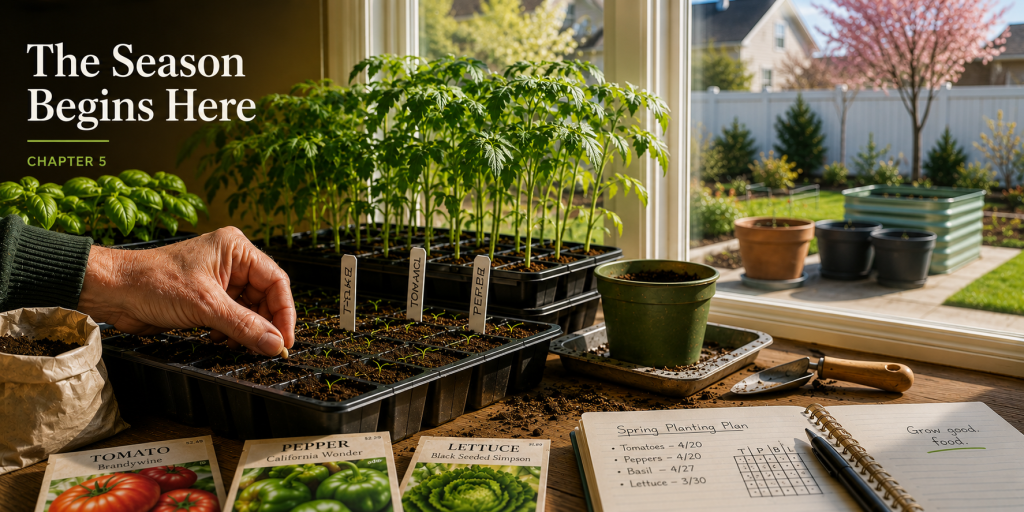
The most successful container gardens begin long before the first plant is set outside.
Every productive garden begins before a single container is filled.
Long before plants reach the patio or balcony, long before the first watering can is lifted, decisions are already shaping the season. Those decisions revolve around one quiet but powerful choice: whether to rely on store-bought plants or start your own transplants.
For urban gardeners, starting transplants isn’t about saving money or chasing perfection. It’s about control. Control over time to transplant. Control over variety. Control over plant quality. And in small spaces, control matters.
Gary’s Garden Note
When you start your own plants, you stop reacting to the season and start guiding it.
Why Store-Bought Transplants Only Go So Far
Garden centers are built to serve a wide audience. Their job is to stock plants that look good on the bench, tolerate inconsistent care, and sell quickly. That’s not the same thing as producing the best plants for container gardens.
Store-bought transplants often:
- Are limited to a narrow range of varieties
- Are grown on schedules that may not match local conditions
- Sit in small cells longer than ideal
- Experience stress during transport and handling
None of this makes them bad plants. But it does mean they’re rarely ideal.
When you start your own transplants, you decide when seeds are planted, how they’re grown, and when they’re ready to move into containers. That control leads to healthier plants and better performance.
Gary’s Garden Note
Convenience is useful — but it always comes with tradeoffs.
Seed Starting Is About Simplicity, Not Equipment
One of the biggest myths surrounding seed starting is that it requires specialized gear or a dedicated space.
It doesn’t.
At its core, seed starting requires just a few essentials:
- Clean containers
- Quality seed-starting mix
- Consistent moisture
- Warmth for germination
- Adequate light after emergence
Everything else is refinement.
The challenge isn’t technology. It’s consistency. Plants don’t need perfection — they need steady conditions.
Gary’s Garden Note
Strong seedlings come from steady care, not fancy tools.
Why Seed-Starting Mix Matters
Just as garden soil doesn’t belong in containers, it doesn’t belong in seed trays either.
Seed-starting mixes are designed to:
- Drain well
- Hold moisture evenly
- Resist compaction
- Support delicate root systems
Dense soils restrict root growth and retain too much water, increasing the risk of damping-off diseases.
Seedlings don’t need nutrients immediately. They need oxygen, moisture, and space to grow roots. A light, well-aerated mix provides exactly that.
Germination: The Waiting Game
Seeds germinate when conditions are right — not when we want them to.
Most vegetable seeds need warmth and moisture to sprout. Some require light. Others require darkness. Knowing these preferences improves success and reduces frustration.
During germination:
- Keep the mix evenly moist, not wet
- Maintain appropriate temperature
- Be patient
Uneven moisture is one of the most common causes of poor germination. Dry spots kill seeds before they sprout. Saturated conditions suffocate them.
Gary’s Garden Note
Germination rewards patience more than effort.
Light Is the Make-or-Break Factor
Once seedlings emerge, light becomes the most important factor in their success.
Seedlings grown in insufficient light stretch toward the nearest source. Stems become thin and weak. Leaves remain small and pale. These plants may survive transplanting, but they rarely thrive.
Good light:
- Keeps plants compact
- Strengthens stems
- Encourages healthy leaf development
- Prepares plants for outdoor conditions
Whether light comes from a bright window, a porch, or grow lights, it must be consistent and close to the plants.
Gary’s Garden Note
You can’t fix a lack of light later — it has to be right from the start.
Timing: Earlier Isn’t Always Better
Starting seeds early feels productive. Unfortunately, it often backfires.
Plants started too early, outgrow their containers, become root-bound, and struggle when transplanted. Stressed seedlings stall, produce poorly, and take longer to recover.
The goal is not the largest plant. The goal is the right plant at the right time.
Short, sturdy seedlings with well-developed roots outperform tall, leggy ones every time.
Gary’s Garden Note
Bigger seedlings aren’t better — better seedlings are better.
Seed-Starting Reference Tables & Timelines
Table 5.1 — When to Start Seeds Indoors
General Rule:
Start seeds indoors based on when plants will be ready, not how early you want them.
| Crop | Start Indoors Before Last Frost | Notes |
| Tomatoes | 6–8 weeks | Too early = leggy plants |
| Peppers | 8–10 weeks | Slow germination, need warmth |
| Eggplant | 8–10 weeks | Similar needs to peppers |
| Basil | 4–6 weeks | Fast-growing, easy |
| Lettuce | 3–4 weeks | Fairly easy |
| Cucumbers | 3–4 weeks | Don’t like root disturbance, better to direct sow |
| Squash (compact) | 3–4 weeks | Transplant carefully, better to direct sow |
| Herbs (parsley, cilantro) | 4–6 weeks | Slow to germinate |
Gary’s Garden Note
Seed-starting success depends more on when you plant out than when you plant in.
Table 5.2 — Ideal Seedling Size at Transplant
Bigger is not better. Ready is better.
| Crop | Ideal Height | Visual Cue |
| Tomatoes | 6–10 inches | Thick stem, deep green leaves |
| Peppers | 4–6 inches | Multiple true leaves |
| Eggplant | 5–7 inches | Compact, upright |
| Basil | 4–6 inches | Branching, aromatic |
| Lettuce | 3–4 inches | Dense rosette |
| Cucumbers | 3–5 inches | One or two true leaves |
| Squash | 3–4 inches | Transplant very young |
Gary’s Garden Note
A plant that looks eager — not desperate — is ready to move.
Table 5.3 — Seed-Starting Light Requirements and Mistakes
| Stage | Light Requirement | Common Mistake |
| Germination | Warmth > light | Letting mix dry out |
| Emergence | Immediate bright light | Waiting “a few days” |
| Early growth | 12–16 hrs/day | Lights too far away |
| Pre-transplant | Strong, even light | Stretching seedlings |
Gary’s Garden Note
Weak light creates weak plants — and weak plants struggle all season.
Table 5.4 — Potting-Up Decision Guide
| Situation | Pot Up? | Why |
| Roots fill starter cell | Yes | Prevents root binding |
| Plant is leggy | No | Light issue, not space |
| Weather delaying transplant | Yes (once) | Buys time |
| Plant already stressed | No | Adds shock |
(this will need a yes/no decision tree)
Gary’s Garden Note
Potting up is a tool — not a routine.
Optional Sidebar — Common Seed-Starting Mistakes
- Starting too early
- Not enough light
- Overwatering seedlings
- Skipping hardening off
- Trying to start everything the first year
Gary’s Garden Note
Every gardener makes these mistakes — the goal is to make them smaller each season.
Understanding When a Transplant Is Ready
A seedling is ready to transplant when:
- Roots hold the soil together
- The plant has several true leaves
- Growth is compact and steady
- Weather conditions are suitable
Plants that linger too long in small containers lose vigor. Those transplanted too early struggle to establish.
Timing is a balance between readiness and opportunity.
Potting Up Without Overdoing It
Some seedlings benefit from being moved into slightly larger containers before final transplanting. This process, known as potting up, gives roots room to expand without stress.
Potting up is useful when:
- Seedlings outgrow starter cells
- Outdoor conditions aren’t ready
- Plants need more time indoors
However, repeatedly potting up plants can slow growth and increase stress. Use this technique sparingly.
Gary’s Garden Note
Every transplant is a reset — minimize unnecessary resets.
Hardening Off: Preparing Plants for Reality
Indoor-grown plants live sheltered lives.
They’re protected from wind, intense sunlight, and temperature swings. Moving them outdoors suddenly can shock them badly.
Hardening off is the gradual process of introducing seedlings to outdoor conditions.
A simple approach:
- Start with short periods outdoors in shade
- Increase exposure over several days
- Gradually introduce direct sun and wind
Skipping this step often leads to sunburned leaves, slowed growth, or plant loss.
Gary’s Garden Note
Outdoor conditions aren’t harsh — they’re just unfamiliar.
Why Home-Grown Transplants Perform Better in Containers
Transplants grown at home are usually:
- Less stressed
- Better adapted to local conditions
- Properly sized for containers
- Ready when the gardener is ready
They establish faster, resume growth sooner, and often produce earlier.
In container gardens, that early momentum matters. Plants that start strong are better equipped to handle heat, pests, and weather stress later in the season.
Starting Small Builds Confidence
You don’t need to start every plant from seed.
Begin with a few reliable crops. Learn the rhythm. Observe what works. Expand gradually.
Seed starting rewards attention and patience. It also deepens your connection to the garden. When you’ve watched a plant grow from seed to harvest, success feels different.
Gary’s Garden Note
Gardening changes when you’ve known the plant since day one.
Seed Starting as a System
Starting transplants isn’t a separate activity — it’s part of the larger gardening system.
It connects planning, crop selection, container choice, and scheduling. When done well, it smooths the entire season.
Urban gardeners who start their own transplants aren’t chasing perfection. They’re building reliability.
Letting Go of Perfection
Not every seed will sprout. Not every seedling will thrive.
That’s normal.
Seed starting teaches resilience — both in plants and gardeners. The goal isn’t flawless trays. It’s enough healthy plants to move forward confidently.
Gary’s Garden Note
Seed starting isn’t about perfection — it’s about participation.
Quick Takeaways
- Starting seeds gives you control over variety and timing.
- Strong transplants lead to better container performance.
- Light is more important than heat after germination.
- Starting later often produces better plants than starting too early.
- Hardening off prevents transplant shock.
- Seed starting doesn’t require expensive equipment.
Gary’s Garden Note
Seed starting isn’t about perfection — it’s about getting started.
Urban Farm Checklist: Seed Starting
☐ Use clean containers and seed-starting mix
☐ Provide bright, consistent light after seedlings emerge
☐ Water gently and consistently
☐ Avoid overcrowding seedlings
☐ Start seeds according to local timing guidelines
☐ Harden plants off gradually before transplanting
☐ Transplant only healthy, sturdy seedlings
Healthy transplants give the garden a strong start, but what happens next determines whether that potential is realized.
Once plants are established in containers, their success depends on what happens next. Of all the factors that influence growth, none is more consistent—or more misunderstood—than water.
In container gardens, watering isn’t just routine — it’s foundational.
That’s where we turn next.

