

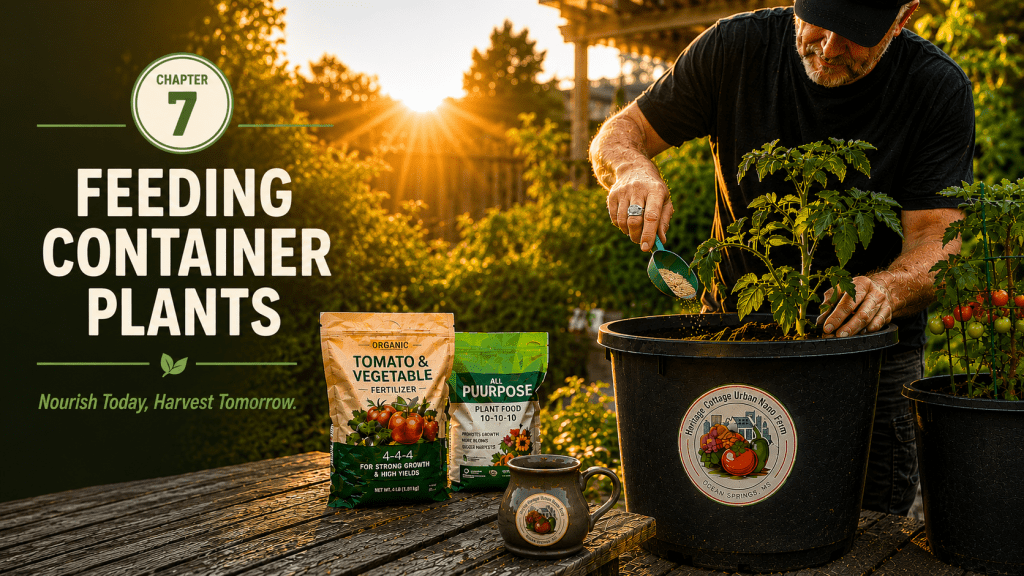
The Urban Farm: Chapter 7
In container gardening, plants depend on you for everything.
When water is managed well, nutrition becomes the next limiting factor in container garden success.
In the ground, soil acts like a pantry. It stores nutrients, buffers mistakes, and provides a slow, steady supply of what plants need to grow. Containers don’t have that luxury. What goes into the container—and what washes out—determines how well plants perform.
That’s why feeding container plants isn’t a bonus step. It’s a core part of the system.
When gardeners struggle with weak growth, pale leaves, poor flowering, or disappointing harvests, nutrition is often part of the story. Not because plants weren’t fed—but because they weren’t fed appropriately.
Understanding how container nutrition works turns fertilizing from a source of confusion into a reliable, manageable routine.
Gary’s Garden Note
Fertilizer isn’t a rescue tool — it’s regular maintenance.
Why Container Plants Need More Attention
Containers create a closed system.
Unlike garden beds, containers don’t receive nutrients from surrounding soil. They don’t benefit from deep mineral reserves. And every time you water properly—until water drains from the bottom—some nutrients leave the container.
That’s not a flaw. It’s part of good container management. But it does mean nutrients must be replaced.
Without regular feeding:
Growth slows gradually
Leaves lose color
Flowering becomes inconsistent
Yields decline
Container plants rarely “crash” from hunger. They fade. And fading is easy to miss until productivity drops.
Gary’s Garden Note
Container plants don’t starve loudly — they starve quietly.
Fertilizer vs. Nutrition: A Helpful Distinction
Plants don’t actually need fertilizer.
They need nutrients.
Fertilizer is simply the delivery system.
The primary nutrients—nitrogen (N), phosphorus (P), and potassium (K)—play different roles in plant growth. Nitrogen supports leafy growth. Phosphorus contributes to root development and flowering. Potassium supports overall plant health, stress tolerance, and fruit quality.
Secondary nutrients and micronutrients also matter, especially in long-season container crops. A balanced approach keeps plants growing steadily instead of lurching between feast and famine.
Gary’s Garden Note
Feeding plants is easier when you know what they’re actually eating.
Organic and Synthetic Fertilizers: Tools, Not Teams
Few gardening topics generate more debate than fertilizer choice.
Organic versus synthetic. Natural versus chemical. Slow versus fast.
In container gardening, these debates are often unhelpful. Both organic and synthetic fertilizers are tools. Each has strengths. Each has limitations. The key is understanding how they behave.
Organic fertilizers:
Release nutrients slowly
Depend on microbial activity
Improve soil structure over time
Synthetic fertilizers:
Act quickly
Deliver precise nutrient ratios
Work regardless of microbial activity
Many successful container gardeners use a combination—slow-release organic or coated fertilizers for baseline nutrition, supplemented with liquid feeding during periods of heavy growth.
Gary’s Garden Note
The best fertilizer is the one you understand how to use.
Slow-Release Fertilizers: The Foundation
Slow-release fertilizers are one of the easiest ways to feed container plants consistently.
These products release nutrients gradually over time, reducing the risk of overfeeding and smoothing out nutrient availability. Applied at planting, they provide a steady baseline that supports early growth.
Release rates are influenced by temperature and moisture. As weather warms and plants grow faster, nutrients become available more quickly—matching plant demand.
Slow-release fertilizers:
Reduce guesswork
Improve consistency
Lower the risk of nutrient burn
They don’t eliminate the need for additional feeding, but they establish a strong foundation.
Gary’s Garden Note
Slow-release feeding sets the tone for the entire season.
Liquid Fertilizers: Fine-Tuning Growth
As plants mature, their nutrient needs increase—especially during flowering and fruiting.
Liquid fertilizers shine in these moments.
They:
- Deliver nutrients quickly
- Allow precise adjustment
- Help correct deficiencies
- Support peak production
The key to liquid feeding is moderation. Frequent, dilute applications are usually safer and more effective than infrequent heavy doses.
Think of liquid fertilizer as support, not stimulation.
Gary’s Garden Note
Steady feeding beats strong feeding every time.
Reading Plants Before Reading Labels
Plants communicate their nutritional status clearly—if you know what to look for.
Pale green leaves, reduced vigor, or stalled growth often suggest nutrient shortages. Excessive leafy growth with little flowering may indicate too much nitrogen.
However, nutrient symptoms can overlap with watering problems, root stress, or temperature extremes. Before adjusting fertilizer, it’s important to rule out moisture issues.
Fertilizer won’t fix stressed roots.
Gary’s Garden Note
When plants look off, check water before changing food.
The Hidden Risk of Overfeeding
One of the most common mistakes in container gardening is assuming that more fertilizer means more harvest.
It doesn’t.
Excess nutrients can:
- Burn roots
- Reduce flowering
- Encourage weak, lush growth
- Increase pest pressure
- Build up salts in containers
Overfed plants often look impressive early but perform poorly over time. Flavor suffers. Stress tolerance drops. Problems multiply.
Occasional flushing with clear water helps remove accumulated salts and reset the root zone.
Gary’s Garden Note
Plants grow best when they’re nourished — not overindulged.
Feeding Changes as the Season Progresses
Container feeding is not static.
Early in the season, young plants need modest nutrition. As growth accelerates, demand increases. During peak fruiting, consistent feeding supports continued production.
Late in the season, excessive feeding may encourage leafy growth at the expense of fruit or delay natural ripening.
Good gardeners adjust feeding as plants change—not because a schedule says so, but because observation does.
How Water and Fertilizer Work Together
Water and nutrients are inseparable.
Water carries nutrients into the root zone. Too little water limits uptake. Too much water flushes nutrients away.
Consistent watering improves nutrient efficiency. Proper container size buffers mistakes. Balanced feeding produces steady growth instead of cycles of stress and recovery.
That’s why Chapters 6 and 7 work as a pair.
Gary’s Garden Note
Water delivers the food — fertilizer just supplies it.
Container Crops With Higher Nutrient Demand
Not all container crops feed the same way.
Heavy producers—such as tomatoes, peppers, cucumbers, and squash—require more consistent nutrition than leafy greens or herbs. Long-season crops also draw nutrients over a longer period.
Matching feeding intensity to crop demand prevents both deficiency and excess.
Flushing Containers: An Overlooked Practice
Over time, dissolved salts from fertilizers and water accumulate in containers.
Periodic flushing—watering deeply with clear water until excess drains freely—helps remove buildup and refresh the root environment.
This simple practice:
- Reduces root stress
- Improves nutrient uptake
- Extends container productivity
- Flushing is especially important in hot weather or when using soluble fertilizers regularly.
Gary’s Garden Note
Sometimes the best feeding is clean water.
Building a Feeding Routine That Works
A good feeding routine:
- Fits your schedule
- Matches your containers
- Reflects crop needs
- Adjusts with growth
There’s no universal plan. The best routine is the one you can maintain consistently.
Container gardening rewards steadiness, not intensity.
Confidence Comes From Understanding
Many gardeners feel uncertain about fertilizing because they’ve been given conflicting advice.
This chapter isn’t about following strict rules. It’s about understanding how container nutrition works so you can make informed decisions.
Once you understand the system, feeding becomes routine rather than stressful—and plants respond accordingly.
Gary’s Garden Note
Confidence in feeding comes from understanding, not memorizing products.
Looking Ahead
Quick Takeaways
- Container plants rely entirely on you for nutrients.
- Nutrients wash out of containers faster than garden soil.
- Both organic and synthetic fertilizers can work.
- Slow-release fertilizers provide steady feeding.
- Liquid fertilizers help during heavy growth or production.
- Over-fertilizing can be just as harmful as under-fertilizing.
Gary’s Garden Note
Feeding plants is about balance, not generosity.
Urban Farm Checklist: Fertilization
☐ Start with a slow-release fertilizer at planting
☐ Read fertilizer labels for proper rates
☐ Supplement with liquid fertilizer as needed
☐ Watch plants for signs of deficiency or excess
☐ Avoid fertilizing dry soil
☐ Flush containers occasionally with clear water
☐ Adjust feeding during peak harvest periods
Well-fed plants grow vigorously. Vigorous plants attract attention—from gardeners and insects alike.
In the next chapter, we’ll look at how to manage pests calmly and effectively, using observation, prevention, and targeted action instead of panic.

