
For four years now, we’ve been growing Datil peppers at Heritage Cottage Seeds. My original seed was given to me by a St. Augustine Master Gardener, which is about as good a starting point as I could ask for with a Datil.
Then last fall I went to St. Augustine.
While I was there, I visited with a couple local pepper growers and, of course, came home with seeds. You know I wasn’t leaving without seeds.
I grew those this year and noticed something pretty quickly. These Datils aren’t quite the same as the ones I’ve been growing.
My original Datils are shorter and a little blockier. Some of these new St. Augustine peppers are longer, narrower and more pointed. And here’s where it gets interesting. Look at descriptions and old references to Datil peppers and you’ll find both shapes.
So which one is the real Datil?
I don’t know. And apparently nobody else knows for sure either.
The Datil is a Capsicum chinense, the same species that includes habaneros and Scotch bonnets. UF/IFAS describes Datil fruit as ranging from spherical to oblong, usually ripening yellow-orange to orange. They’re hot, commonly listed around 100,000 to 300,000 Scoville units.
But heat isn’t really the whole Datil story.
There’s a fruity sweetness underneath that heat that makes a Datil taste like a Datil. Once you’ve grown and tasted them, you understand why folks around St. Augustine have kept them going for generations.
Where they originally came from gets a little fuzzy.
The Datil is closely tied to the Minorcan families who came to St. Augustine in 1777 after leaving Andrew Turnbull’s settlement at New Smyrna. You’ll often hear that the Minorcans brought the pepper with them. Maybe they did. There are also historical connections suggested with Cuba and the Caribbean.
UF/IFAS is careful about this. The exact origin of the Datil isn’t known.
What we do know is that St. Augustine adopted this pepper and made it their own.
Datils became part of backyard gardens and family recipes. Seeds were saved and handed down. The peppers found their way into Minorcan clam chowder, sauces, relishes, mustards, jellies and probably quite a few family recipes nobody ever bothered to write down.
And that brings me back to my peppers.
When families save seed generation after generation, they’re also making selections, whether they realize it or not. Save seed from the plant you like best and do that long enough, little differences can become bigger differences.
Maybe that helps explain the short, blocky Datil I was originally given and the longer peppers I brought home from St. Augustine.
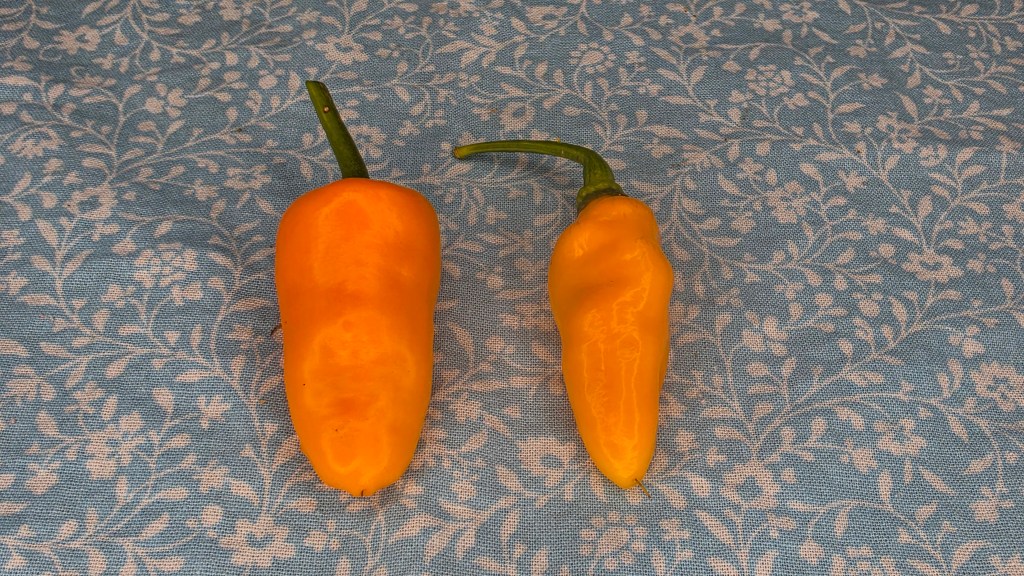
Which one is the true Datil?
Maybe both.
And I actually like the story better that way.
A pepper doesn’t have to be perfectly uniform to have history. Sometimes the differences are part of the history.
And now a few more pieces of that St. Augustine Datil story are growing here at Heritage Cottage Seeds in south Mississippi.

